The Dogs of the Dow
DJIA Value Investing
The Dogs of the Dow is a large cap value investing strategy focused on the 30 stocks of the Dow Jones Industrial Average (DJIA). Popularized by Michael O’Higgins (he didn’t call it Dogs of the Dow) in his 1992 book, Beating The Dow, the strategy is offered in many online stock screeners as a predefined screen.
As a value investing strategy,
this is as simple as it gets.
To screen for the Dogs, sort the 30 stocks of the DJIA by their dividend yield and buy the top 10 in equal dollar amounts. That is simple.
One year later (or a year and a day later), you sort the DJIA by dividend yield and replace stocks no longer in the top 10 with stocks that now appear in the top 10. Again, you buy (or rebalance) in equal dollar amounts.
Historical Performance
For the years 1973 through 1991, the strategy yielded a total return of 1753% (according to O’Higgins). That is an annual compound return of 16.6% versus the DJIA’s annual total compound return of 10.4% during the same period.
O’Higgins also identified a more volatile, more profitable variation (now referred to as the Little Dogs or Small Dogs of the Dow). From the highest 10 yield stocks, you buy equal amounts of the five with the lowest cost per share. The annual compound return? For the test period, it was 19.4%.
James O’Shaughnessy (Predicting The Markets of Tomorrow) likens the Dogs of the Dow to the Fama/French Large Value Index. From 12/31/1928 through 12/31/2004, the real average annual return was 8.63 percent compared to the Fama/French Index real average annual return of 8.24 percent. The S&P real average return during this period was 6.29 percent.
The following is a back-test of the dogs from 1/1/2009 through 12/31/2016 generated on the Portfolio123 screener. The refresh period was 3 months, not 1 year. The red line is the dogs equity curve. The annualized return was 16.65% but the draw-down was also pretty impressive (it happened in the 1st quarter of 2009).
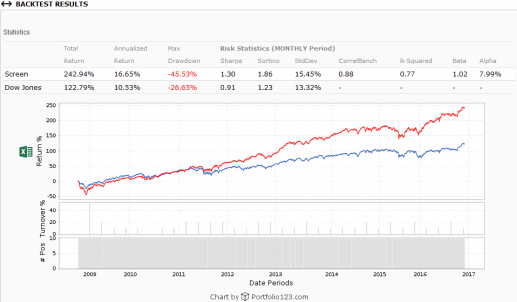 Dogs of the Dow backtest
- NOTE -
Remember that real average annual return is the total return beyond inflation, not just the total return of capital gains and dividends.
O’Shaughnessy also points out that the Dogs of the Dow had a smaller standard deviation than the Fama/French Large Value Index. He suggests it can be the large cap value component of a stock portfolio.
In What Works on Wall Street, O’Shaughnessy determined that the compounded annual total return from 1963 to 2003 was 13.9%. Not as good as the results of the more limited data used by O’Higgins.
What is the Basis of the Strategy?
The basis of this investing strategy is the dividend yield valuation model. Every company has occasional down periods where their stock price drops. As long as they do not lower their dividend, their yield will increase. In this case, high yield is a simple way to identify the beaten down Dow companies.
Because the strategy applies to the bluest of the blue chip stocks, the Dow Industrials, additional criteria are ignored. The rationale is that these are the very best companies and do not require extensive analysis to determine if they will recover. However, being a component of the DJIA guarantees neither longevity nor success. Witness the recent demise of General Motors.
Since this is mechanical investing, proponents suggest no further analysis once the screening is complete. On the other hand, it is prudent to confirm the dividend is expected to continue. Check out the companies passing the screen to see if bad news is in the making.
For example, Citicorp was one of the selections in January 2008. Checking the news, it became apparent that a dividend cut was a real possibility. The cut did occur. Citicorp dropped in price about 20% through September before getting crushed along with the rest of the market.
Diversification Using the Dogs
A diversified investment portfolio normally includes a large cap value component. If you want such a component, O’Shaughnessy (as noted elsewhere) thinks this is an option.
One of the reasons for choosing the Dogs as the large cap value component of a portfolio is the small number of stocks required to satisfy the strategy. Most large cap value strategies recommend 20 or more stocks to achieve the same level of volatility.
The Dark Side of the Dogs
It is simple and it works, what isn’t there to like? There are several common criticisms of the strategy. Even if you do not intend to use the Dogs, they may be worth understanding.
Variations
There are variations to the base strategy to overcome the criticisms. These variations can turn this simple strategy into a valuable component of a portfolio. Learn about the variations and the screeners to implement them.
Dogs of the Dow Screens
For the original Dogs, the best stock screener is a free stock screener. Many screeners also offer backtesting and alternative screens for the Dogs of the Dow.
Can’t get enough of the Dogs?
If not, there is an entire site devoted to the Dogs . It has an interesting remark by O’Higgins on his current thinking in this area.
-
101 Home
›
-
Strategies
›
-
Dogs
HOME | Site Policies | Contact Us | About Me | About Site | Site Map
Popular Pages
CANSLIM Strategy
Folio Investing
Economic Indicators
Portfolio123
Ranking Systems
New
We value your suggestions, comments, and questions.
Our goal is to make this site as useful as possible.
Contact Us
Thanks!
Stock screening tools and consistent, sustainable investing processes.
About Me
Why build a website instead of a blog?
About this site
Jan 2017