Timing the Market
for the Long Term
While I do not use market timing for day-to-day investing, timing the market to evaluate investing conditions for the long term seems crucial to preservation of capital. By long term I mean the 3 to 5 year periods Dow Theory refers to as the tides of the market - not the waves or ripples.
Published systems seem to be fairly simple and use the same set of indicators for both the exit and entry to the market. For example, the Golden Cross system described elsewhere on this site uses a shorter MA crossing a longer MA for both buy and sell signals depending on which direction the crossover occurs. These systems seemed to have too many whipsaws.
My goal was to identify a system using multiple technical indicators with few whipsaws in the historical data. One indicator identifying the start of a favorable market and another the start of an unfavorable market. Giving up an early entry and hanging on a little too long seemed preferable to whipsaws.
Channel Commodity Index (CCI)
While examining the monthly price data of the S&P 500, I noticed the 17 period CCI had some excellent exit signals with regard to avoiding a large drawdown. But the entry was later than seemed reasonable.
After reading The Ivy Portfolio by Faber and Richardson, I was curious to consider the effect of a monthly close above a simple moving average. By observation (not by optimization), I felt the S&P 500 closing for the month above the 11 month simple moving average was a reasonable entry signal.
However, I was only looking at 15 years of data.
NOTE: Visit the Chart School at StockCharts.com for a detailed explanation of moving averages and the commodity channel index (CCI).
Timing the Market for 50 years
How good was this over time? It is not too difficult to decide using historical price data and a spreadsheet.
Getting the data is as simple as going to Yahoo! Finance and downloading the monthly data for the S&P 500 since it's inception in March 4, 1957.
Next, construct the 17 period CCI and the 11 month simple moving average in the spreadsheet alongside the monthly data.
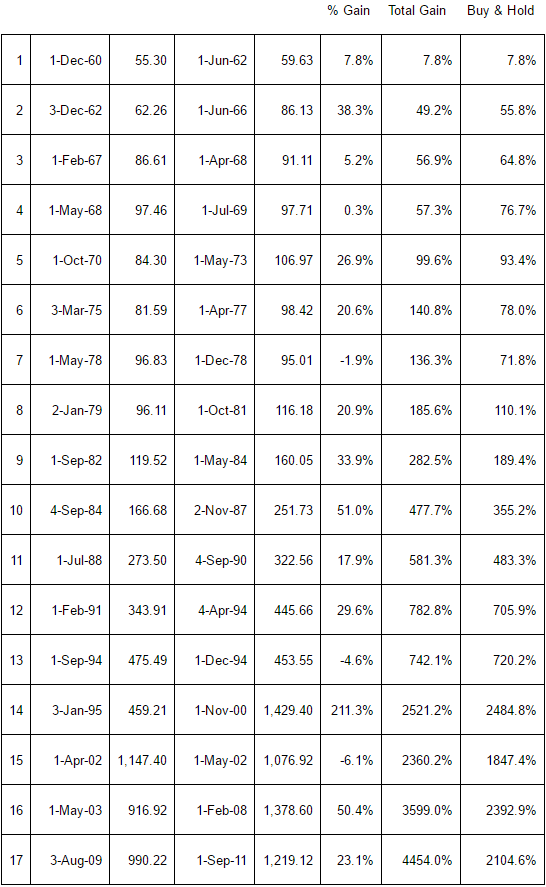
I began the evaluation starting on December 1, 1960 after the S&P 500 closed November above the 11 month simple moving average indicating a favorable market. This signal continued until May 1962 when the 17 month CCI went negative indicating an adverse market.
Through September 2011, there have been 17 favorable markets using this market timing technique. The results are shown in the following table. Notice that sometimes timing the market outperforms, sometimes buy and hold outperforms.
Note: the chart does not consider the system beyond the end last exit in September, 2011.
Timing the Market with CCI
Although the current market condition is published on this page, you can follow this signal using any charting system with monthly S&P 500 index data, CCI indicator, and simple moving average. Be certain to use index data that is not adjusted for dividends since that will have a different chart pattern.
- Reminder -
Past performance is no guarantee of future results.
HOME | Site Policies | Contact Us | About Me | About Site | Site Map
Popular Pages
CANSLIM Strategy
Folio Investing
Economic Indicators
Portfolio123
Ranking Systems
New
We value your suggestions, comments, and questions.
Our goal is to make this site as useful as possible.
Contact Us
Thanks!
Stock screening tools and consistent, sustainable investing processes.
About Me
Why build a website instead of a blog?
About this site
June 2020