The Importance of Market Cap
Market capitalization is the stock market value of a company. In other words, how big is the check you need to write in order to buy all the common stock? To calculate a company's market value, multiply the number of shares of stock (published in the most recent company financial data) by the current market price of each share.
For example, a company with 10 million shares outstanding selling for $2.50 per share has a market cap of $25 million. If the shares were selling for $75.00 per share, the cap would be $750 million.
Market segmentation by cap (grouping companies by their cap) is a way to organize the market for analysis. The idea is that companies with similar caps are similar in other respects as well. There is lots of research on investment performance to confirm this segmentation is valid.
The research shows variations in performance, volatility, and trade-ability between stocks from different classifications. So market classification by cap is worth understanding.
How small is small, how big is big?
While there is general agreement on the category names (nano cap, micro cap, small cap, mid cap, and large cap), the actual range used to define the categories is not consistent. It varies from analyst to analyst and it varies over time.
Not much we can do to address the analyst to analyst problem, but we can address the variation over time problem.
Rather than using the same fixed cap regardless of the point in time we are studying, we will always assign market percentiles as the category ranges. This allows us to be consistent within the context of the market at any point in time. This is how researchers have addressed the problem.
Later, when screens are developed that consider cap, we will use the percentile ranking if available in the data.
Site definition of market cap classifications
Throughout this site, we will use the following percentiles to classify stocks by cap:
- Nano Cap: The bottom 35% of the range. As of March 2016 (according to the AAII Stock Investor Pro database), the largest market cap in this category was about US $61M.
- Micro Cap: The 30% of the range from the 36ᵗʰ to the 65ᵗʰ percentile. As of March 2016, the actual micro cap range was about US $61M to US $768M.
- Small Cap: The 20% of the range from the 66ᵗʰ to the 85ᵗʰ percentile. As of Mar 2016, the actual small cap range was about US $768M to US $4.48B.
- Mid Cap: The 10% of the range from the 86ᵗʰ to the 95ᵗʰ percentile. As of March 2016, the actual mid cap range was about US $4.48B to US $19.9B.
- Large Cap: The top 5% of the range. As of Mar 2016, the actual market cap for this class exceeded US $19.9B.
The chart below illustrates the distribution in each category by numbers of companies.
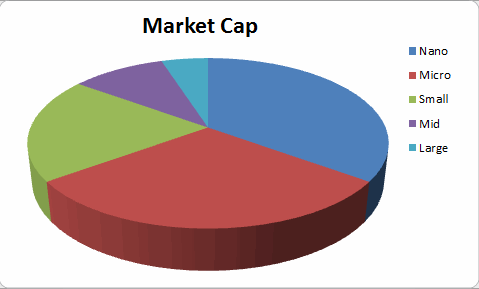
Note, however, that the chart does not illustrate the distribution of total capitalization. Even though only 5% of all companies fall into the large cap category, the total capitalization of the large caps exceeds the capitalization of any other category.
Average capitalization within the categories is consistent with the market cap range of the S&P 1500 which includes the S&P 600, S&P 400 and the S&P 500 indices. As of March 2016, the smallest cap in the S&P 1500 was about US $59M - the lower range of Micro Cap. The Russell 3000 includes Nano Cap stocks.
Next, Market Timing
-
101 Home
›
-
Basics
›
-
Market Cap
HOME | Site Policies | Contact Us | About Me | About Site | Site Map
Popular Pages
CANSLIM Strategy
Folio Investing
Economic Indicators
Portfolio123
Ranking Systems
New
We value your suggestions, comments, and questions.
Our goal is to make this site as useful as possible.
Contact Us
Thanks!
Stock screening tools and consistent, sustainable investing processes.
About Me
Why build a website instead of a blog?
About this site
Updated Mar 2016