Stock Investing Styles
Since there are a variety of investing styles, consider all your options before deciding on a personal investment strategy. Don't get sidetracked.
Don't gamble; take all your savings and buy some good stock and hold it till it goes up, then sell it. If it don't go up, don't buy it.
Will Rogers
Since the tongue-in-cheek investing style recommended by Will Rogers is not really possible, we are left with 3 basic approaches:
- technical
- fundamental
- blackbox
1 - Technical Analysis
Technical analysis (TA) relies on the price action of the stock. The price and volume are analyzed using mathematical functions referred to as indcators.
TA is most often identified with trading, not investing, since the financial merit of the company may not be a consideration.
But that is not all that is in play.
Learning technical analysis is also useful for trading/investing in ETFs and for analyzing market conditions - i.e., market timing.
For beginning investors and sophisticated investors alike, the technical approach to the market place can be rewarding. Books and articles on this approach abound, and there are excellent stock screening tools (e.g. MetaStock) designed to identify stocks and ETFs that satisfy your technical indicators.
And it can be approached in a quantitative manner.
Our primary focus with TA on StockScreening101 is Market Timing. As a result of extensive testing with MetaStock, we have identified alternative time periods that re-create our published results. In some cases, improving the results.
If your focus is ETFs, technical analysis tools are sufficient with the exception that you may not have access to the dividend yield of the ETF. But that can be a subsequent analysis. Other than short interest, yield is the only fundamental criteria available for an ETF.
2 - Fundamental Analysis
Fundamental analysis relies on the financial data supplied by the company. Perhaps because it considers the financial merit of the company rather than price action, fundamental analysis is usually associated with investing.
Fundamental analysis is often broken down further:
- Value Investing
- Growth Investing
- Growth and Value Investing (GARP)
- Income Investing (aka dividend investing)
The breakdown is driven by the fundamental criteria used to identify value, growth and income.
Value Investing
In The Little Book of Value Investing, Christopher Brown likens value investing to buying things on sale "Buy Stocks like Steaks ... On Sale". Note the implicit quality of "steaks". As long as the quality of what you buy is good, you buy it for as little as possible.
Warren Buffet, maybe the worlds most famous value investor, puts it this way "buy a good company at a fair price, not a fair company at a good price".
You get the idea.
Growth Investing
The core idea is to buy growing companies with the expectation that as the company grows, the price of the stock will grow. And you will make money.
And there are lots of fundamental criteria to measure growth - just like there are lots of fundamental criteria to measure value.
GARP - Growth at a Reasonable Price
This mix of value and growth investing searches for companies exhibiting growth while at the same time being fairly priced.
You look for growing companies that are still on sale.
Income Investing
According to many studies, companies (and groups of companies in ETFs and CEFs) that pay dividends are the out-performers over time.
But not everyone agrees with that analysis.
Therefore, if you take an income approach to investing, you can focus on the dividends paid or the total shareholder yield produced by the companies. And value and growth (especially of dividends) matter.
In any case, you expect to generate income in the form of dividends.
3 - Black Box Investing Style
Subscribing to a service to obtain a list of recommended stocks or ETFs to buy is the black box investing style. Black box means you don't set up the criteria personally and have at most only general knowledge of how the recommendations are derived.
You can't see inside the box.
That isn't necessarily bad, but it probably means you won't be learning much about how to make your own selections.
An exception would be taking the list provided by the service or website and doing additional technical and/or fundamental analysis to choose which of the recommendations to buy.
For example, the Magic Formula Investing site is free with registration and provides a list of 30 or 50 stocks meeting the Magic Formula criteria. You don't know the exact magic to produce the list but it is created by the author of the book.
The list below shows the top 30 companies with at least US 250 M in market cap.
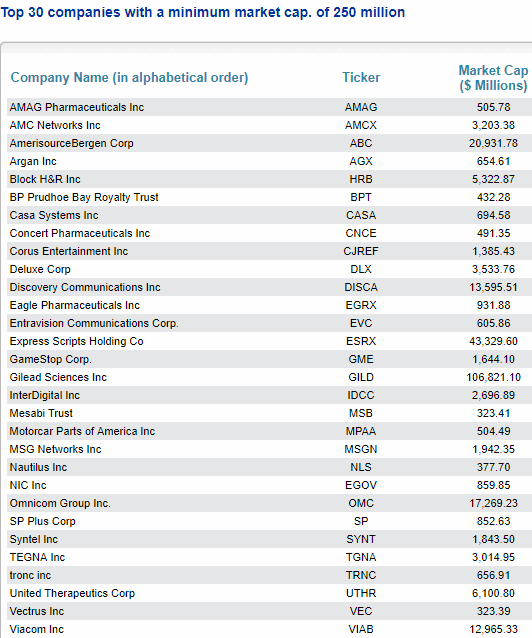
You can buy all the passing companies.
Or you can apply some of your own magic to reduce the list to those companies you think are best.
Are these investing styles Oil and Water?
No.
It is common to use both fundamental and technical analysis within a strategy. For example, you might adopt a growth investing strategy and use technical indicators to identify entry and exit points.
Or you might use value investing techniques to create a list of acceptable stocks and then apply technical analysis to determine if market conditions are favorable.
Next, Market Cap
HOME | Site Policies | Contact Us | About Me | About Site | Site Map
Popular Pages
CANSLIM Strategy
Folio Investing
Economic Indicators
Portfolio123
Ranking Systems
New
We value your suggestions, comments, and questions.
Our goal is to make this site as useful as possible.
Contact Us
Thanks!
Stock screening tools and consistent, sustainable investing processes.
About Me
Why build a website instead of a blog?
About this site
Feb 2018