"Best Books on Investing"
Beating The Dow – Michael O’Higgins
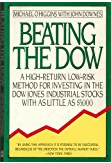
Beating the Dow is the Dogs of the Dow strategy and a must inclusion in any best books on investing list if you are going to consider a developing a basic strategy.
This is not stock picking. It is a simple, quantitative value investing strategy first suggested by Benjamin Graham and elaborated on by O'Higgins.
The book has four sections
1. Why the Dow Jones Industrial Average (DJIA) stocks?
The author first makes the case for selecting stocks rather
than real estate or gold as a long term strategy. After that, he narrows down the universe of stocks to just the DJIA stocks.
O’Higgins considers himself a contrarian (with market timing tendencies) rather than a value or growth investor. His goal is to use the stocks in the DJIA as a means to outperform index investors and mutual funds as well as outperform the Dow (his benchmark).
The first section concludes with a brief history of the DJIA and the price weighting used to compute the value.
2. Components of the DJIA (circa 1991)
A brief discussion of each of the members of the average is included as well as the annual returns of each from 1973 to 1991. Note that these are the 30 companies comprising the DJIA in 1991.
It is interesting to read the analysis of these companies with a 1991 perspective but I would not buy a book on investing just to get this type of analysis.
But the most interesting bit of information in the section is that every one of the companies regularly paid a solid dividend - it was an expected part of the investing culture. This leads to one of the criticisms of the strategy using the current members of the DJIA. Some of the current members pay very small dividends.
3. Markets and Cycles
An interesting look at the markets of the 60s, 70s, and 80s by someone who was in the market at the time. Not all books on investing offer this perspective. The real point is that the market has both ups and downs.
4. Last but not least - Beating the Dow
The (currently) well known strategy was developed and described using data from 1973 through mid-1991. It is interesting that O’Higgins did not refer to the strategy as The Dogs of the Dow. The limited time frame has led to criticism but other researchers have since confirmed the findings over longer periods of time.
The conservative version identifies the 10 stocks with the highest yield, buys them in equal dollar amounts and holds them for a year. This is commonly referred to as the Dogs of the Dow.
A more volatile version of the strategy is to buy equal dollar amounts of the five lowest priced stocks of the 10 stocks. The five stock version is commonly referred to as the Small Dogs of the Dow. The most volatile version is to buy the single stock of these five with the next to the lowest price.
The rationale for a high-yield strategy is included.
Other Highlights
The book concludes with an analysis of how other value criteria (lowest PE, Price/Book, etc) and momentum criteria worked on the DJIA over the 1973 to 1991 time frame. These other strategies are often totally ignored when the Dogs of the Dow are discussed.
One thing to remember. The Beating the Dow approach is unique in that it only has one stated factor for choosing companies. This is unusual, particularly since the strategy was first developed by investing legend Ben Graham. The rationale for using only one factor is the quality of the universe. In other words, a second factor is inherent in the universe.
If you want to dig deeper online, there is a site devoted to this approach. The book is a simpler way to start.
This is worth reading. If you can’t borrow it and don’t own it, buy it - or buy the revised version. Neither is expensive.
O’Higgins, Michael with Downes, John. Beating The Dow: A High-return, Low-Risk Method for Investing in the Dow Jones Industiral Stocks with as little as $5000 (Harper-Perennial, 1992).
About the author of Beating The Dow
Michael O’Higgins was a top-ranked money manager and president of Michael B. O’Higgins & Co. in Albany, NY, at the time the book was written.
HOME | Site Policies | Contact Us | About Me | About Site | Site Map
Popular Pages
CANSLIM Strategy
Market Timing
Portfolio123 Screener
Ranking Systems
We value your suggestions, comments, and questions.
Our goal is to make this site as useful as possible.
Contact Us
Thanks!
Consistent, sustainable investing processes.
About Me
Why build a website instead of a blog?
About this site
Updated Jan 2017